At noon across Singapore, thousands of meals go out at once: to a preschool in Punggol, a nursing home in Bishan, a worker dormitory in Tuas, and a factory canteen along the west coast. Feeding all of them well, safely, and on budget is the job of institutional catering. Unlike a one-off buffet, institutional catering means daily, large-scale meals for a fixed group of people, built around nutrition, dietary needs, and strict food safety. This guide explains what institutional catering covers in Singapore, the sectors it serves, how meals reach the table, what it costs, and how to choose a dependable provider.
What Is Institutional Catering?
Institutional catering is the ongoing, large-scale provision of daily meals to a defined community such as a school, hospital, dormitory, or workplace.
The difference from event catering or a one-off cafeteria service is consistency and scale. An event caterer impresses once, but an institutional caterer delivers the same safe, nutritious quality every single day, often for hundreds or thousands of people. That shift changes how the kitchen, menus, and logistics are run, and it is why institutional catering sits apart from general catering services in Singapore that focus on parties and functions.
Who Uses Institutional Catering in Singapore?
Institutional catering serves several distinct sectors, each with its own rules and priorities.
Schools and Education
From preschools and student care centres to MOE schools and institutes of higher learning, education is a major user. Menus follow the Health Promotion Board (HPB) Healthier Dining and school canteen guidelines, with controlled portions, less sugar and salt, and child-friendly variety. Here, nutrition and safety matter far more than flair.
Healthcare and Eldercare
Hospitals and nursing homes need the most precise meals of all. Beyond halal and vegetarian choices, they require therapeutic diets such as diabetic, renal, and low-sodium, plus texture-modified meals that follow IDDSI standards for residents with swallowing difficulties. Here, accuracy is a clinical requirement, not a preference.
Dormitories and Industrial Sites
Worker dormitories and factories call for high volume, halal by default, and meals timed around shifts, sometimes around the clock. On-site kitchens and onsite catering are common in this sector because steady, large numbers justify a dedicated setup.
Corporate and Government Workplaces
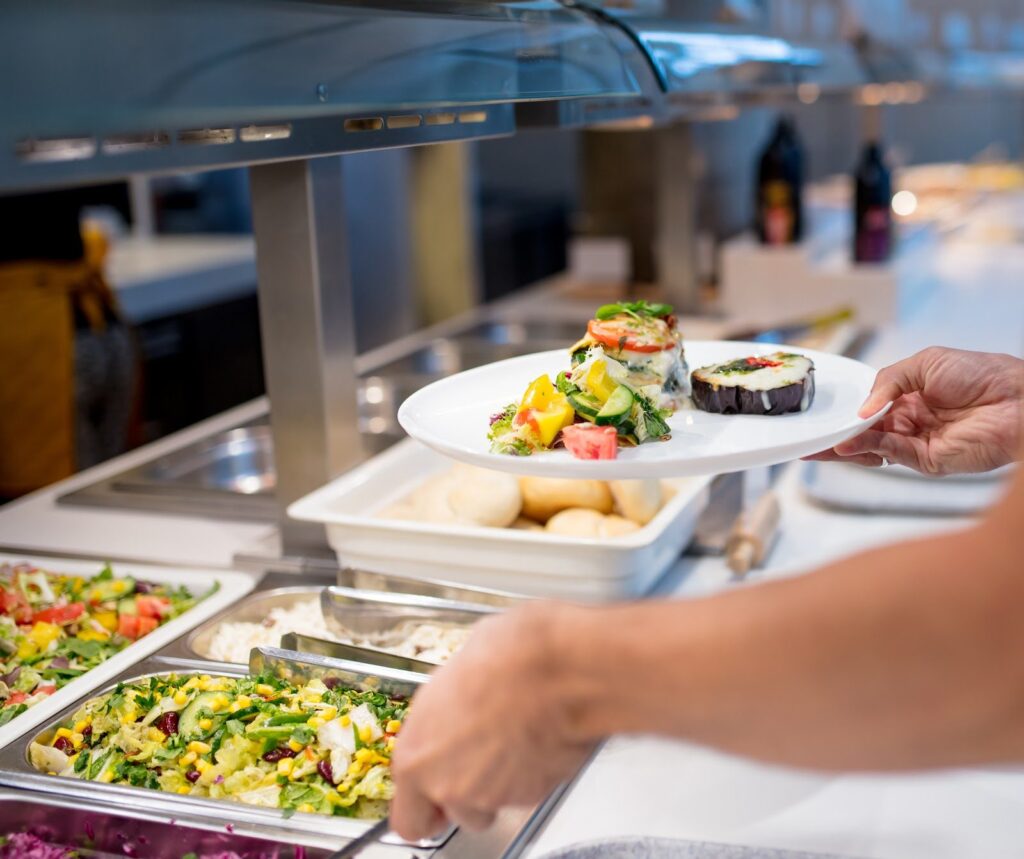
Offices, ministries, and industrial employers run a daily cafeteria service and staff canteen meals to keep teams fed and productive. Variety, fair pricing, and reliability are the priorities, which is where institutional catering overlaps most with everyday staff canteen management.
What Makes Institutional Catering Different
Three things set institutional catering apart from ordinary catering: scale, nutrition, and compliance.
- Scale: meals are produced in central kitchens engineered for consistency, so the thousandth tray matches the first.
- Nutrition: menus increasingly align with Singapore’s HPB Healthier Dining Programme and Healthier Choice guidance, a common client requirement today.
- Compliance and dietary range: every kitchen must hold the right Singapore Food Agency (SFA) licence, and most carry MUIS halal certification, alongside vegetarian, allergen-aware, and therapeutic options.
| Sector | Top Priority |
| Schools and preschools | Child nutrition, HPB guidelines |
| Healthcare and eldercare | Therapeutic and texture-modified diets |
| Dormitories and factories | Halal, high volume, shift timing |
| Corporate and government | Variety, value, daily reliability |
Onsite or Central-Kitchen Delivery?
Institutional meals reach the table in one of two ways, and many sites use both.
Onsite catering services put a team at your premises to cook, finish, or serve, giving the freshest result and suiting large sites with steady numbers. Central-kitchen delivery prepares meals off-site as ambient, chilled, or ready-to-eat dishes and brings them in, which needs no kitchen infrastructure and scales easily. Larger institutions often blend the two, using onsite catering for the main daily service and delivered meals for satellite locations or overflow. Choosing between them comes down to your space, headcount, and how steady the numbers are.
What It Costs and How to Choose a Provider
Cost depends on volume, meal type, dietary complexity, and service model. Pricing usually follows a per-meal rate, a management fee, or a flat monthly fee, with therapeutic or specialised menus costing more than standard ones. Unlike smaller catering services in Singapore that quote per event, institutional providers price around daily volume and consistency.
When comparing providers, check:
- Licensing: SFA-licensed, MUIS halal-certified, with a clean inspection record.
- Sector experience: proven work in your setting, whether school, healthcare, dormitory, or workplace.
- Nutrition capability: in-house nutrition planning for HPB alignment and special diets.
- Scale and kitchens: central-kitchen capacity to hold quality at volume.
- Reliability and reporting: on-time delivery plus clear consumption and cost data.
For workplaces deciding whether to run the operation themselves, our guide on corporate lunch catering services covers daily meal formats in more detail.
Frequently Asked Questions
How is institutional catering different from corporate catering?
Corporate catering often covers events and daily office meals, while institutional catering spans whole sectors such as schools, healthcare, and dormitories at larger scale, with stricter nutrition and compliance.
Is institutional catering in Singapore halal-certified?
Most established providers hold MUIS halal certification, and in dormitory and many workplace settings halal is the default standard rather than an add-on.
Does institutional catering follow HPB healthier-eating guidelines?
Increasingly yes. Schools and many workplaces expect alignment with the HPB Healthier Dining Programme, including lower sugar, salt, and oil, plus Healthier Choice ingredients.
Can providers handle special or therapeutic diets?
Healthcare-focused caterers manage diabetic, renal, low-sodium, and IDDSI texture-modified meals, alongside vegetarian and allergen-aware options.
Onsite or delivered, which suits a large site better?
Large sites with steady numbers usually benefit from onsite catering services, while delivered central-kitchen meals suit smaller or spread-out locations.
How is this different from running our own staff canteen?
Institutional catering can be delivered as a managed service, so you avoid operating the kitchen yourself. Our corporate cafeteria management guide explains that choice in full.
Choosing the Right Institutional Catering Partner
Institutional catering in Singapore comes down to trust at scale: clean, nutritious, compliant meals delivered the same way every day, whether to students, patients, dormitory residents, or staff. Match the provider to your sector and volume, confirm their licensing and nutrition capability, and the daily job of feeding your people becomes something you never have to worry about. As a workplace food service partner, Canteen Crew focuses on exactly this kind of dependable, large-scale staff canteen and institutional catering.